Why exercise matters so much in AS
In ankylosing spondylitis and axial spondyloarthritis, exercise is treatment — not an add-on. Medicines control inflammation; daily stretching and strengthening keep the spine, hips and chest mobile and your posture upright. People who exercise regularly have less pain, less stiffness and better function.
A 15-minute daily routine
A warm shower first loosens the joints — mornings are often stiffest, so many people find the evening easier. Do what you can; consistency matters more than intensity.
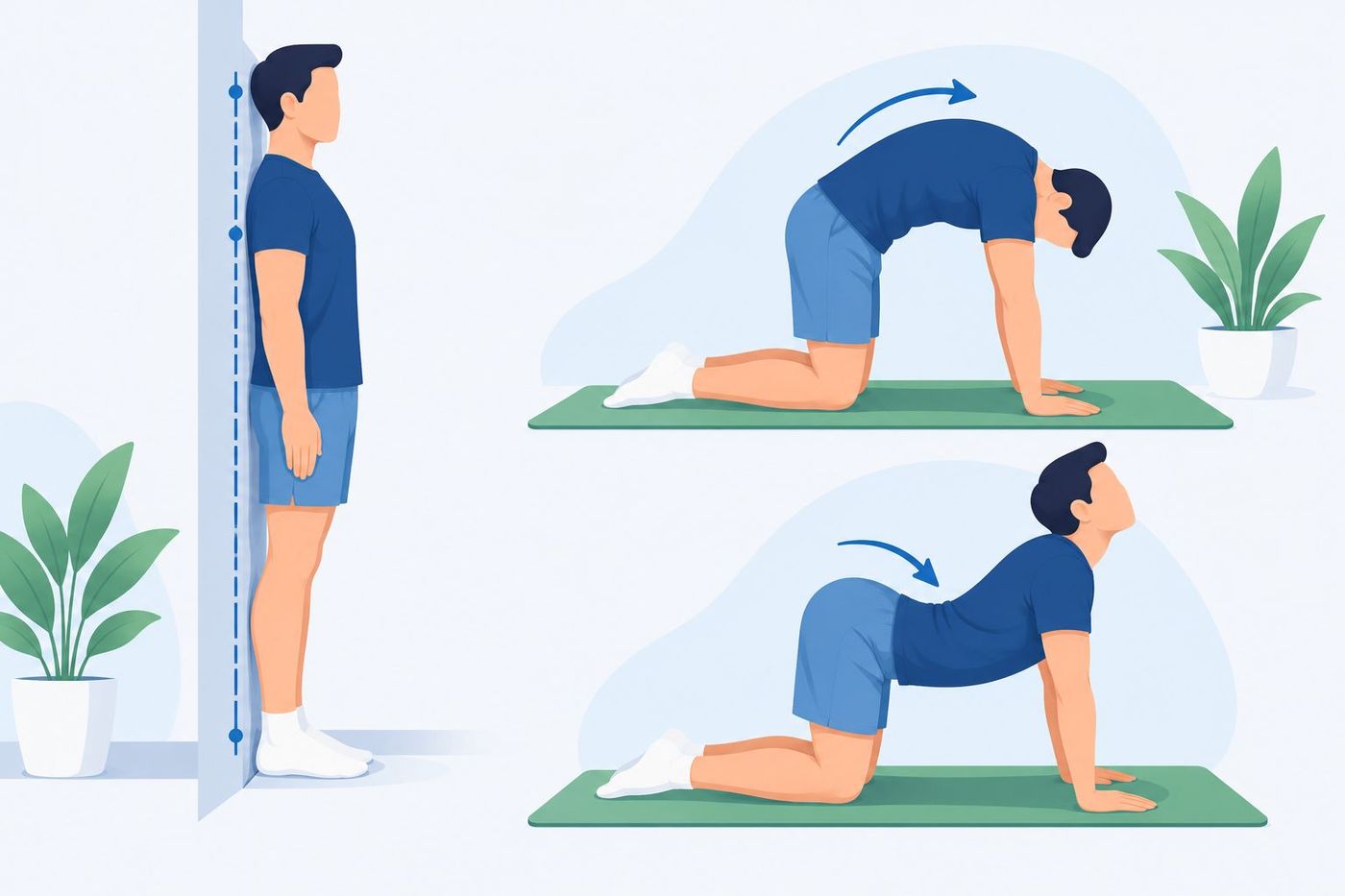
Stand with heels, buttocks, shoulder blades and the back of your head against a wall. Tuck your chin slightly. If your head doesn't reach the wall, don't force it — use a thin book and aim to reduce it over time.
Do: Hold 30 seconds, 3 times, daily. A good way to track posture.
Sitting or standing tall, slide your chin straight back (making a "double chin") without tipping the head down.
Do: 10 slow repetitions, twice a day.
Sit tall, squeeze your shoulder blades back and down, as if holding a pencil between them.
Do: Hold 5 seconds, 10 times.
On hands and knees, slowly round your back up towards the ceiling, then let it sink gently, lifting your head. Move with your breath.
Do: 10 slow repetitions.
Sit on a chair, arms crossed over your chest. Turn your upper body to one side as far as is comfortable, looking over your shoulder. Return and repeat to the other side.
Do: 5 each side, holding 5 seconds.
Kneel on one knee (with a cushion), the other foot forward. Keeping your back straight, gently push your hips forward until you feel a stretch at the front of the kneeling hip.
Do: Hold 20–30 seconds, 3 times each side.
Lie on your front on a firm surface for 10–20 minutes a day, gradually building up. It helps keep the hips and spine straight. Use a thin pillow under the chest if needed.
Do: Once a day — while reading or watching TV.
Place your hands on the sides of your lower ribs. Breathe in slowly and deeply, feeling your ribs push your hands outwards; breathe out fully.
Do: 10 breaths, twice a day — keeps the chest mobile.
Lie on your back, knees bent. Tighten your buttocks and lift your hips to make a straight line from shoulders to knees.
Do: Hold 5 seconds, 10 times.
Beyond the routine
- Swimming is ideal — it moves the whole spine and chest without jarring
- Brisk walking, cycling and yoga (avoiding forced extreme positions if the spine is already fused)
- Avoid high-impact contact sports if the spine is stiff or osteoporotic
- Sleep on a firm mattress with a thin pillow
- Take breaks from sitting every 30–45 minutes